
Russia's Gas Sector in 2026: Gazprom Faces European Losses, Limited Chinese Growth, and LNG Reliance
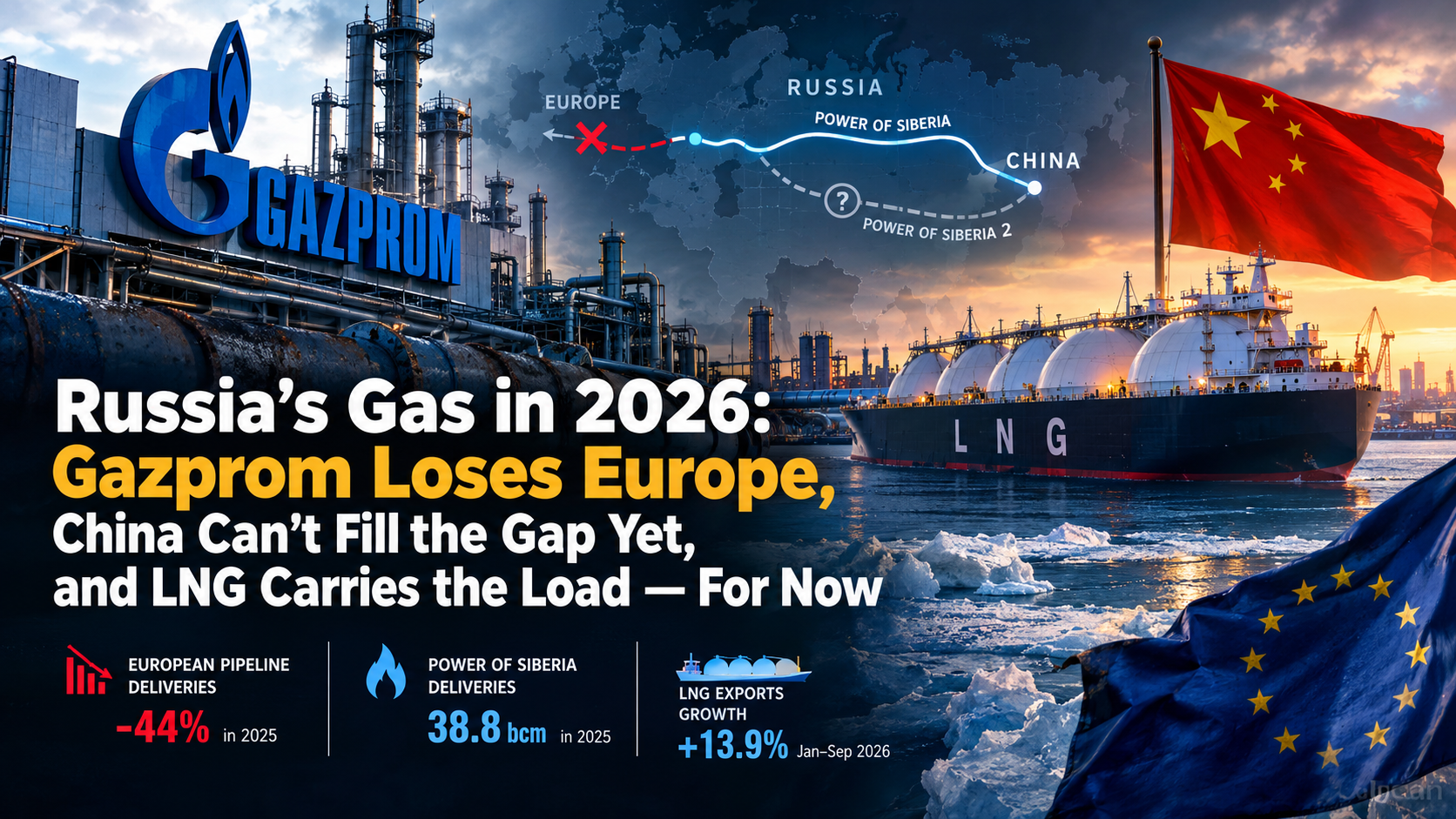
As Gazprom's pipeline exports to Europe collapse and Power of Siberia reaches full capacity, Russia turns to LNG exports for growth, although profits and stability remain uncertain for the sector.
Gazprom's 2025 Financial Results and Dividend Decisions
In 2025, Gazprom reported mixed financial results under different accounting standards. According to IFRS, its revenue fell by 8.8% to 9.77 trillion rubles, EBITDA declined 6% to approximately 3 trillion rubles, while net profit increased 7% to 1.3 trillion rubles. However, this boost in net profit stemmed from a stronger ruble and the revaluation of foreign-currency debt, not from underlying business improvements. The parent company's RAS accounts showed a net profit of 11.3 billion rubles on revenue of 5.85 trillion rubles, down 6.6%. These RAS figures only reflect the standalone parent entity and are not directly comparable to IFRS group results.
Three key factors overshadow nominal net profit: first, Gazprom’s board recommended skipping 2025 dividends—a proposal shareholders approved on June 29, marking four consecutive years without payouts since the last payment in 2022. Second, debt remains significant: net debt stood at approximately 6.05 trillion rubles at the end of 2025 (with reports noting total debt near 6.7 trillion rubles), and the net debt to EBITDA ratio rose to 2.07x from 1.83x, close to the dividend policy ceiling of 2.5x. By the end of Q1 2026, net debt had eased to 5.82 trillion rubles, with the ratio improving to 1.91x. Third, Gazprom’s share price hit 99.9 rubles intraday on June 22—the lowest since 2009 according to Reuters—closing at 100.65 rubles.
The company bears high fixed costs for pipeline infrastructure, even as the direction of exports changes. Shrinking access to high-margin European markets coincides with substantial Asian investment commitments, contributing to ongoing financial strain and the lack of dividends despite nominal profits.
Structural Decline in European Gas Exports
Gazprom's pipeline deliveries to Europe fell 44% in 2025—their lowest since the mid-1970s—according to Reuters. This sharp and structural decline stems from the cessation of Ukrainian transit and the EU’s ongoing initiative to eliminate Russian gas imports. Currently, TurkStream is Gazprom's sole operational pipeline route to Europe, while the Yamal–Europe pipeline has stood idle since 2022. The company’s loss of the European market has thus become a long-term structural issue, not merely a seasonal fluctuation.
Power of Siberia — Natural Gas Deliveries to China (2019–2026)
| Year | Actual deliveries (billion m³) | Year-on-year change | Key development |
|---|---|---|---|
| 2019 | 0.33 | — | Pipeline deliveries commenced |
| 2020 | 4.10 | +1,142.4% | Deliveries ramped up |
| 2021 | 10.39 | +153.4% | Expansion under the supply schedule |
| 2022 | 15.40 | +48.2% | Kovyktinskoye gas field connected |
| 2023 | 22.73 | +47.6% | Continued ramp-up in deliveries |
| 2024 | 31.12 | +36.9% | Reached the planned annual supply level by year-end |
| 2025 | 38.84 | +24.8% | Exceeded the original 38 bcm annual design capacity |
| 2026 H1 | Exact figure not confirmed here | Higher than H1 2025 | Further infrastructure expansion is relevant to future growth |
Sources: Interfax and Reuters, based on Gazprom data. The 2026 H1 figure requires confirmation from a published source. Historical figures are rounded; annual growth rates are calculated from the displayed values.
It's not the strongest of the species that survive, nor the most intelligent, but the one most responsive to change.
China: Dependence on Power of Siberia, Uncertainty Around Power of Siberia 2
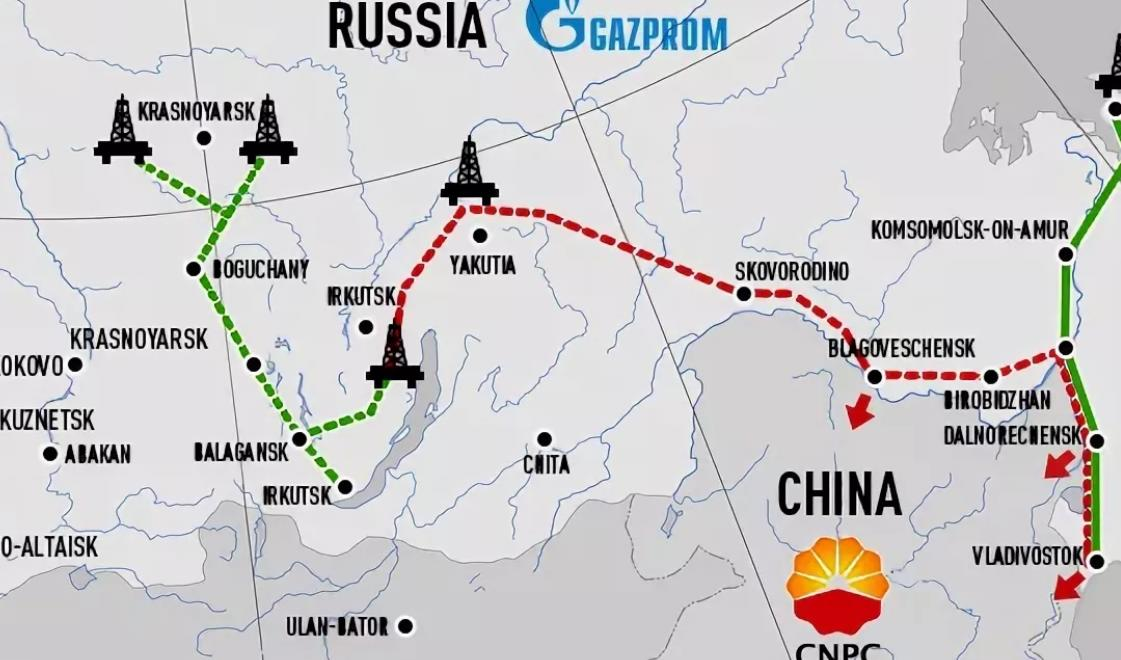
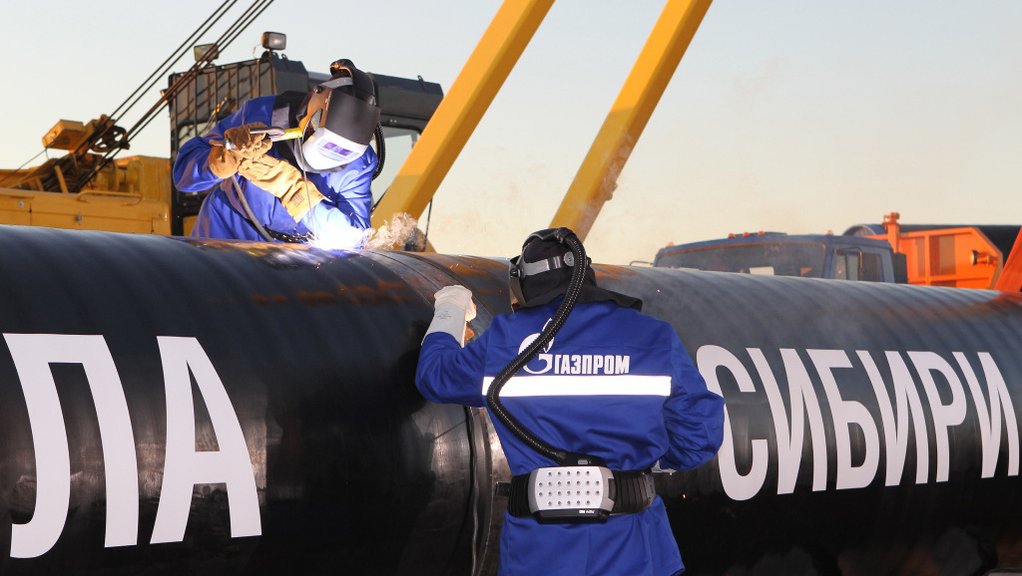
Russia’s only significant growth channel for pipeline gas in 2026 is the Power of Siberia route. Operational since 2019, this pipeline has a design capacity of 38 billion cubic meters per year under a contract with CNPC lasting to 2049. Deliveries have ramped up sharply: 22.73 bcm in 2023, 31.12 bcm in 2024, and 38.84 bcm in 2025—surpassing the annual target by 0.84 bcm. In the first half of 2026, deliveries outpaced the same period in 2025, although precise figures were not disclosed.
While China is a stable long-term buyer, further growth beyond the current capacity depends on infrastructure expansion. Gazprom is planning additional pipeline sections to boost capacity, but 38 bcm is not a fixed upper limit. However, Russia faces a weakened negotiating position as the loss of European markets limits its alternatives. This does not directly prove China benefits from buying at a discount, but it does affect market power dynamics.
The future of Power of Siberia 2, a pipeline through Mongolia intended to replace lost European demand with West Siberian gas, remains unresolved. As of October 10, 2026, no commercial agreement or timeline exists. President Putin’s May 19–20 visit to Beijing produced no concrete contract, and as of August, media reported continuing price disagreements. For the Russian side, unlocking a large new market is crucial; for China, pricing, demand, and conditions are key. Due to these outstanding issues, Power of Siberia 2 cannot yet be treated as a guaranteed source of revenue for Russia.
LNG: Growth Amid Sanctions and Market Uncertainties
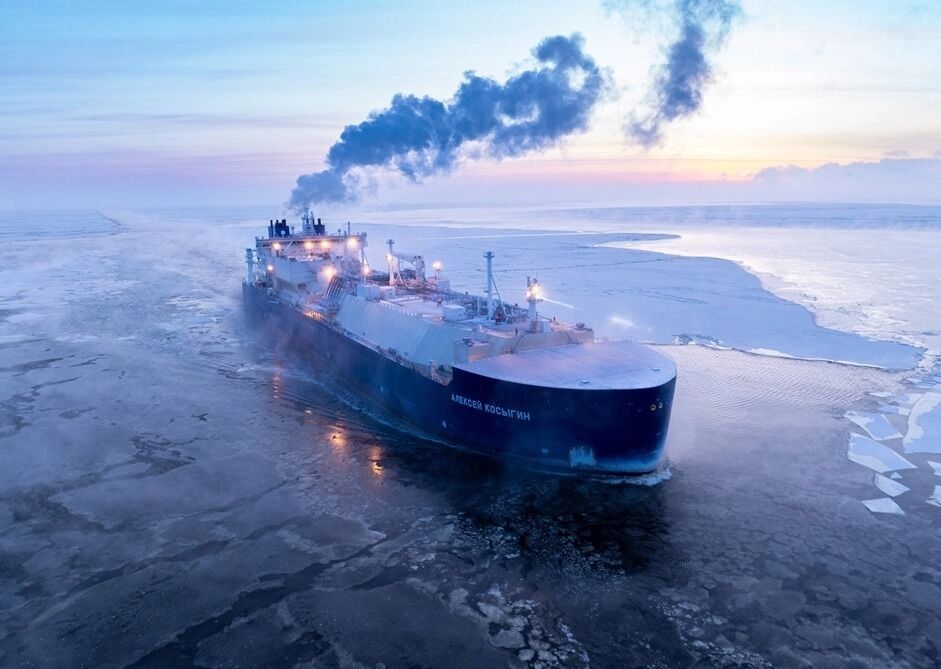
In 2026, LNG remains the only Russian gas segment with real growth. According to LSEG, LNG exports reached 24.6 million tonnes in January–September, up 13.9% year over year. LNG’s flexibility—transportable by ship rather than pipeline—is a major advantage, but Arctic projects require specialized ice-class ships, as well as complex maintenance, financing, and customer access.
Three major projects comprised nearly all of Russia’s LNG volume: Yamal LNG produced 13.7 million tonnes, Sakhalin-2 delivered 7.2 million tonnes, and Arctic LNG 2 accounted for about 3.4 million tonnes despite facing Western sanctions. These projects together summed to 24.3 million tonnes, with minor additional contributions from other sources.
Trade in sanctioned LNG remains technically possible, even if costlier due to restrictions on vessels, insurance, and maintenance. Notably, Russia continues to earn from LNG sales to Europe. Urgewald, using Kpler data, estimated EU ports received 12.18 million tonnes from Yamal LNG in January–September—worth roughly €7.88 billion—with project deliveries rising 9.5%. This estimate is based on delivered volume, energy content, and indicative TTF prices, not Gazprom’s contract revenue. It also does not account for discounts or logistics costs. LSEG’s estimate for all Russian LNG exports to Europe in the same period was lower, at 11.14 million tonnes, which may reflect different methodologies or coverage. The two figures could not be reconciled from open sources.
The Outlook: Policy Shifts, Logistics, and Financial Pressures
The EU’s ban on Russian LNG is being phased in stages. Restrictions on new contracts have been in place since March 18, 2026, and short-term contracts since April 25, 2026. From January 1, 2027, the ban begins to apply to LNG under long-term contracts signed before June 17, 2025, while for pipeline gas under similar contracts, the deadline is September 30, 2027, or November 1 in certain cases. Thus, the LNG export growth seen in 2026 is not necessarily sustainable; some sales will need redirection to Asia, requiring new buyers and logistics solutions.
In summary, the future of Russia’s gas sector will depend less on physical production volumes and more on realized prices, transport costs, and the willingness of China or other buyers to offset volumes lost in Europe. Currently, physical exports are being restructured more rapidly than financial results recover. Neither Power of Siberia 2 nor Asian LNG markets can yet guarantee a return to previous revenue and profit levels for the industry.